
Lost (and Found) in Translation
– How we're collaborating both with AI and our readers to bring our stories to new audiences across the language borders

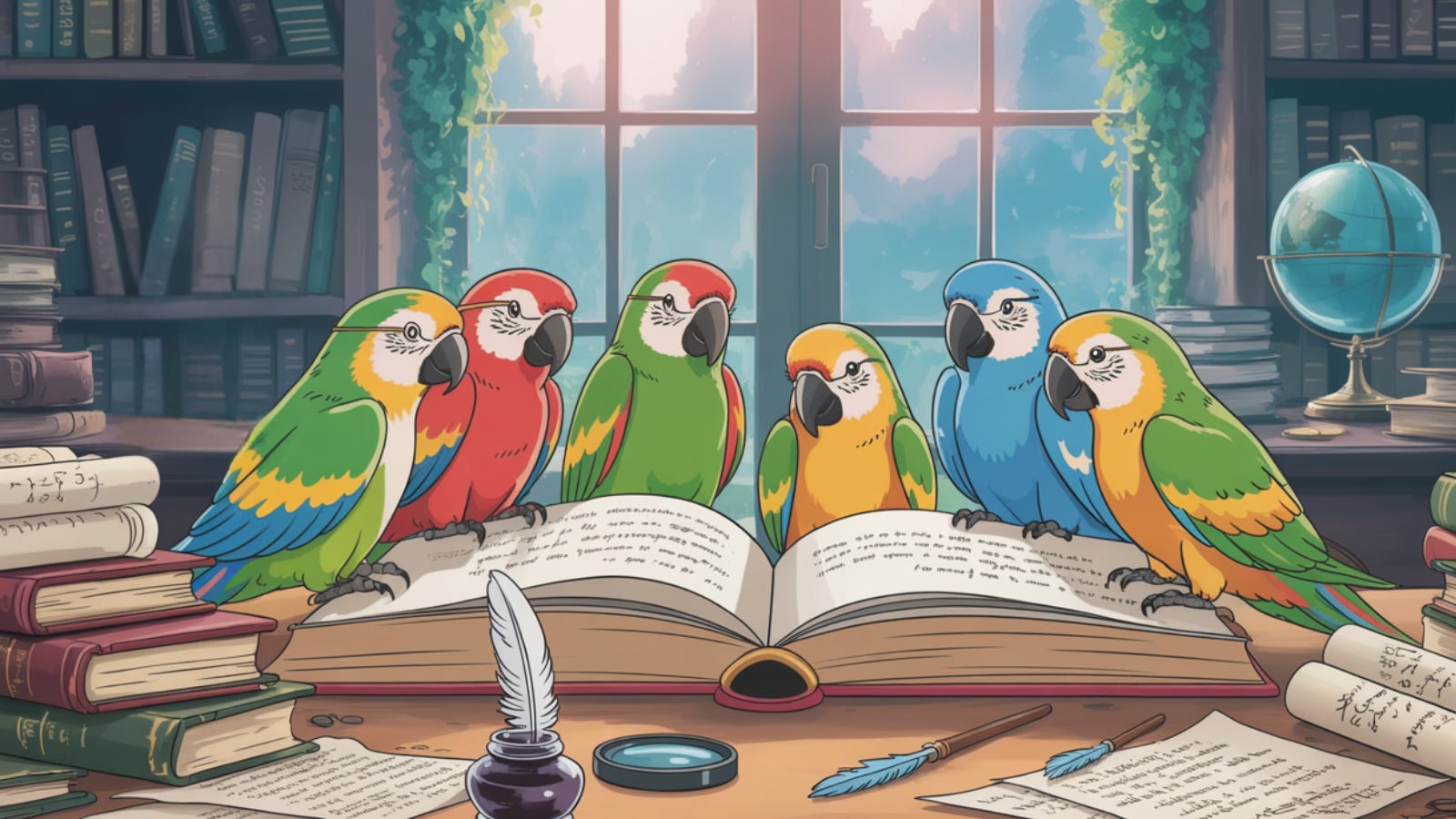
Our polyglot parrots hard at work. Probably.
Hej Messmate!
We’ve had a few questions about our translations and how we work on them, so I thought I’d share a few words on my background and current workflow for anyone who’s curious.
First of all, I’ve been something of a polyglot parrot since childhood, but I’m not a certified translator. I’m a bilingual qualified teacher who spent six years at university studying Linguistics, Literature, and Communication.
So, what do I know about translations?
To be honest, I have never translated fiction before. What I have done is a lot of non-fictional translations, both professionally and for my own purposes. It doesn’t make me a translator and, in an ideal world, I would prefer to hand this delicate task over to someone else. We’re still plankton in the vast publishing sea, though, so that’s not an option for us. Not yet.
To be able to offer our readers a multilingual gateway to stories that cross borders and connect cultures, we have decided to harness the power of AI.
ScribeShadow and My Swedish Workflow
First of all, I run the original text through a wrapper1 called ScribeShadow2. I appreciate their affordable price point and high accuracy rate. It’s not perfect, but that’s true for professional translators, editors, and authors as well. So far, it has done better than any machine translation I’ve seen. I also like the fact that ScribeShadow is a small, family-run team of indie publishers, not a big tech company, and if you need help they’ll respond within minutes on their Discord.
So, once you have an account you can upload your books, add your metadata, and choose your target language. You can see which AIs they recommend in different languages and run tests to find the best fit for your project.
I normally start with a translation from English to Swedish as that is my native language. Reading the Swedish translation and highlighting the things I disagree with (or flat out dislike!) gives me a good idea of what to look out for in other languages as well.
The Swedish translation is the one I spend the most time on. I comb through every sentence, making sure it makes sense and sounds the way I want it to. Then I have Jeeves, my AI assistant, read both the original and my revised translation and flag any inconsistencies he can find. Then I work through his list, changing the things I agree with and discarding the rest.
Once that is done, I take my now twice revised text over to my second AI assistant Claude and ask for his feedback. Again, I get a list of things that may need tweaking and follow the same protocol as before.
Now I run my translation through LanguageTool, an Open Source variant of ProWritingAid that can handle more languages. This is like having a proofreader checking your text for things that may have slipped through the net, but I rarely find anything but names highlighted.
After all this, we come to the hardest part of all. Putting the text away and let it rest for a few days at least. The longer the better. Why? Because it give me a chance to give it a final read-through with my fresh reader eyes on.
Navigating Familiar Waters
Remember I said I’ve always been a polyglot pirate? I’ve picked up a lot of language just by listening and trying to read books, magazines, and newspapers. I have also studied a lot of languages in different schools over the years. Other than Swedish and English, I wouldn’t enter a conversation in any of them, but reading and writing is different.
When no one is looking at you, expecting an immediate response, you can take your time. This is what I do with French, German, and Spanish.
First of all, I go back to Jeeves with my final Swedish version. He already has the original, and he has already discussed changes between English and Swedish with me. With that in mind, I now ask him to give me a list of the problems he can see us getting in each of these three languages. Once I have that, I can start a new chat for each language in the folder/project.
Going back to ScribeShadow, my book is already there so all I need to do now is to choose my next target language and start a new translation. Unlike book writing, this really is as easy as pressing a button and wait for the book to be done. A few minutes later, I have a new translation downloaded as a word document.
I take this translation back to Jeeves and ask him to read it a, specifically looking for issues related to list he made based on the English to Swedish translation; and b, any other issues he can find. Then we do the take it or leave it thing again, keeping changes I like and discarding those I disagree with.
This time, Claude gets to read both the original and the revised translation, flagging whatever he thinks we need to change. And now we start a game of translation tennis that only ends when the three of us agree that we’ve polished the text as much as we can. This may include reaching out for help from other sources as well as sleeping on word choices.
When no one has the will or energy to fight or argue anymore, I take the final version over to LanguageTool to look for things we might have missed. And once that part of the process is done, we leave the text to rest while we work on the next language of the ones I actually have some degree of proficiency in.
Charting Unknown Territories
Yes, you read that right. We are actually attempting to translate our books into languages I don’t know as well. Sir Bear speaks and reads South American Spanish and Japanese, but he doesn’t have the time or nerd level interest in word-wrangling I do. So, here’s my workaround…
We start as before by asking both Jeeves and Claude what issues they can see us running into based on what we have learned from all the previous translations of the same original.
I run a new translation through ScribeShadow and bring it back to them for revisions and feedback. I find that Claude is more of a laid back American surfer dude where Jeeves can be a bit of an overzealous school teacher. That’s actually a good thing. Now, we do the translation tennis again with me double checking with Google translate and other sources (including the Sir Bear and other family members) where we can’t seem to reach an agreement.
As before, we take the final version to LanguageTool for the last mop-ups of things we might have missed.
The Final Stages Before Publication
This is where you, dear reader, come in. We have decided to publish all translations on Substack before we format and pack them up as books we can sell.
We see this as a collaborative journey between man and machine, and we’d love to share it with our readers. Regardless of language, our goal is to preserve the heart of each story we bring to a new audience, and we’re always looking to improve.
Each translation we release has gone through extensive work and revisions, and we read everything ourselves before we release it to Substack. But we know we’re not infallible - every piece of feedback helps us chart a truer course between languages and cultures. So if you spot something that doesn’t quite ring true, sing out!
I’m listening,
Linnea 🏴☠️
What Do You Want to Do Next?
🏠 Home
➡️ Check Language Options
🏴☠️ Visit The Resilience stack
🌐 About Our Translations
We use ScribeShadow to translate our stories and we’re always looking for feedback and readers who want to join the crew as ARC and proofreaders.
📬 Do You Want Updates in Your Own Language?
Join our mailing lists and/or subscribe to our Substack and choose your language(s) in account settings.
☕ Do You Like Our Stories?
Make a small donation to our Ko-Fi fund.
🎁 Do You Have a Friend Who Would Enjoy Our Stories?
Use the share button below, or copy the page link and pass it on.
✍️ Would You Like to Leave a Comment or Send Us a Message?
Use the button below, or come see us in the polyglot chat.
~
A wrapper is essentially a tool, or a software layer, that can use AI models to perform specific tasks. Because the wrapper already knows what it is meant to do – like translating novels for example – the user (you) doesn’t have to figure out what it needs to know to do the job.
ScribeShadow is an AI-powered platform specifically made for novel translations. Use our code POLYGLOTPIRATES to get 50% off your first month if you want to give it a go.